Tech
10 min read

Airtable OMNI as an Operating System for Modern SMBs

Written by
Singular Agency
Published on
January 3, 2026
Share article

Why SMBs Need an Operating System, Not More Tools

Most SMBs don’t suffer from a lack of software. They suffer from a lack of structure.

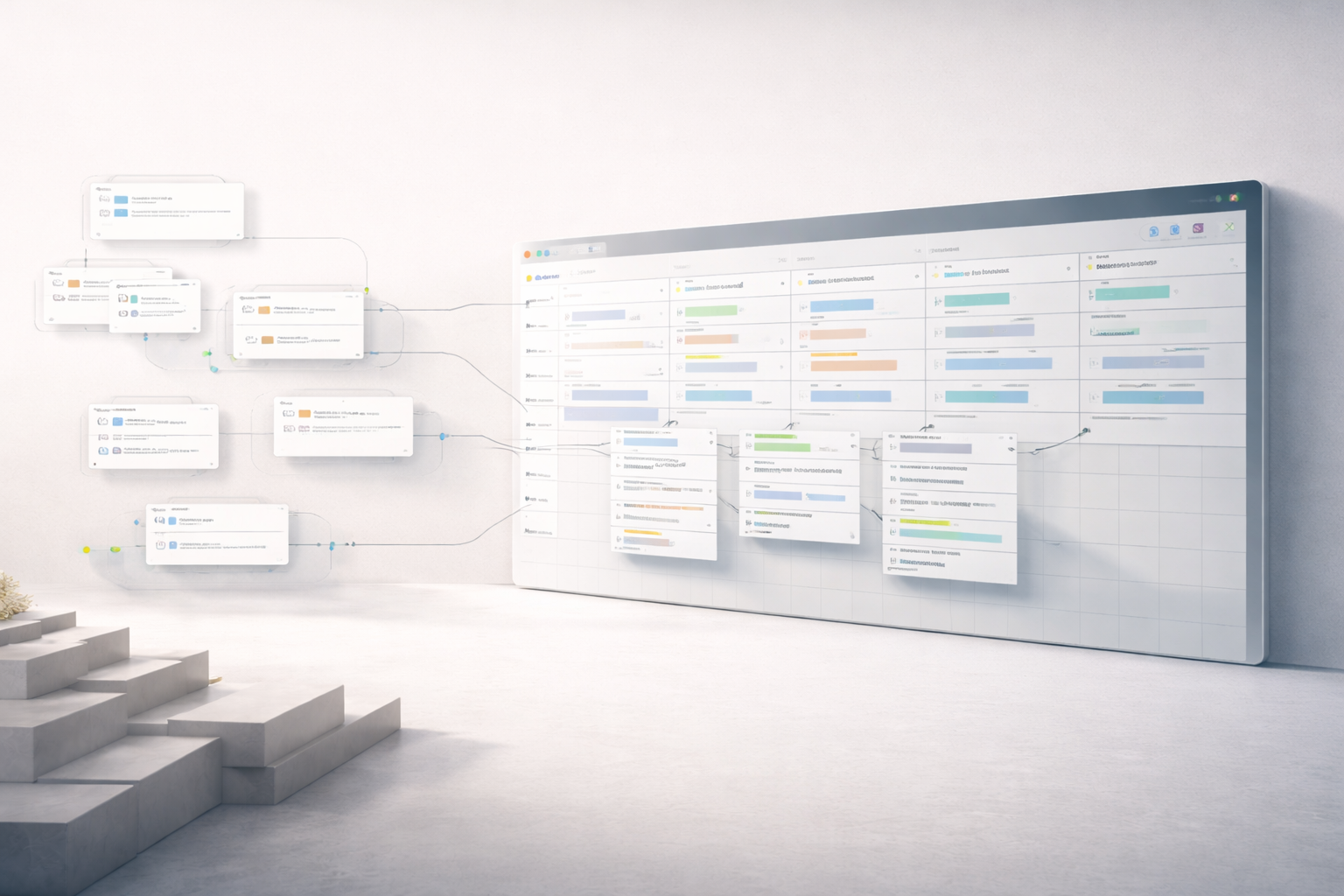
Modern SMB operations team reviewing an interconnected workflow system, representing Airtable OMNI as an operating system for business execution.
Airtable OMNI acts as an operating system by centralizing workflows, data, and execution for modern SMB operations.

Over time, growing teams accumulate tools for CRM, operations, finance, support, and reporting. Each tool solves a local problem, but collectively they create fragmentation. Data lives in multiple places, workflows break between teams, and leaders lose visibility into how work actually flows.

Digital transformation initiatives often fail because organizations struggle to translate strategy into operational execution.
(Source: Wikipedia – https://en.wikipedia.org/wiki/Digital_transformation)

For SMBs, this breakdown happens faster and hurts more. Without an operational backbone, growth increases complexity instead of leverage.

What Does “Airtable as an Operating System” Actually Mean?

Centralized operational workspace showing connected workflows and data layers, illustrating Airtable as an operating system for SMB operations.
An operating system approach allows SMBs to manage workflows and decisions from a single, centralized system.

Calling Airtable an “operating system” does not mean replacing every piece of software an SMB uses.

It means using Airtable as the central logic layer where:

  • core operational data lives
  • workflows are defined
  • rules and ownership are enforced
  • systems connect without duplicating logic

This is the foundation of Airtable OMNI: a structured approach where Airtable becomes the system that orchestrates operations across the business.

Airtable OMNI: The Operating System Layer for SMBs

Traditional operating systems manage hardware resources.
Operational systems manage how work moves.

Airtable OMNI functions as an operating system by:

  • centralizing operational data
  • defining workflows across teams
  • triggering automations and integrations
  • supporting execution without rigid enterprise constraints

For modern SMBs, this provides a balance between flexibility and control that spreadsheets, CRMs, or ERPs alone cannot offer.

Learn more about how we design these systems at Singular Innovation:
👉 https://www.singular-innovation.com/

Why Airtable Works for Operations Management

Airtable is uniquely positioned for operations management because it combines:

  • structured relational data
  • flexible interfaces
  • automation capabilities
  • integration with external tools

Unlike traditional tools that enforce fixed schemas, Airtable adapts as SMB operations evolve. This makes it ideal for businesses that are growing, changing, and refining processes in real time.

This is why many teams adopt Airtable for operations management long before they consider heavier systems.

From Tools to Business Systems

Most SMBs use Airtable as a database or tracker. OMNI elevates it into a business system.

An Airtable-based operating system:

  • replaces ad-hoc spreadsheets
  • connects CRM, ops, finance, and support
  • enforces workflow logic
  • creates visibility across the organization

This shift—from tools to systems—is what enables scale.

You can see how this transition works in real implementations through our Success Stories:
👉 https://www.singular-innovation.com/success-stories

Core Components of an Airtable Operating System

1. Centralized Data Models

All operational entities—customers, orders, tasks, assets—live in a shared data model. This eliminates duplication and misalignment between teams.

2. Workflow Logic

Statuses, approvals, and transitions are encoded directly into Airtable, making execution explicit and repeatable.

3. Interfaces for Execution

Teams interact with systems through role-specific views and interfaces, reducing complexity and errors.

4. Automation and Integrations

Airtable OMNI connects to external tools (Slack, email, billing, analytics) while keeping logic centralized.

Operationalizing Digital Transformation with Airtable OMNI

Digital transformation requires changes in processes, organizational structures, and ways of working—not just technology adoption.
(Source: OECD – https://www.oecd.org/digital/)

Airtable OMNI operationalizes transformation by:

  • embedding structure into daily workflows
  • reducing manual handoffs
  • improving data accuracy
  • enabling incremental automation

Instead of large-scale system replacements, SMBs modernize operations step by step.

Where AI Fits into the Airtable Operating System

AI is most effective when built on top of structured systems.

Within Airtable OMNI, AI can:

  • enrich records with context
  • prioritize work
  • detect anomalies
  • support decision-making

Without a central operating system, AI creates noise. With OMNI, AI becomes a multiplier.

This execution-first approach ensures AI supports the business instead of distracting it.

Common SMB Mistakes When Using Airtable

  1. Using Airtable as a spreadsheet replacement only
    This limits its value and scalability.
  2. Duplicating logic across tools
    Workflow rules should live in one place.
  3. Over-automating too early
    Structure must come before automation.
  4. Ignoring ownership and governance
    Systems need clear accountability.

Airtable OMNI avoids these pitfalls by design.

Why Partners Matter When Building Airtable-Based Systems

Building an operating system is not about configuration—it’s about architecture.

SMBs benefit from partners who:

  • understand operations deeply
  • design scalable data models
  • plan for growth, not just current needs

At Singular, we work closely with our ecosystem to deliver production-ready Airtable operating systems. Learn more about our collaborators on the Partners page:
👉 https://www.singular-innovation.com/partners

Measuring Success: Is Airtable Actually Scaling Operations?

Progressive operational workspace showing growth from a simple setup to a larger organized system, symbolizing scalable Airtable-based business systems for SMBs.
When Airtable functions as an operating system, SMB operations can scale without adding complexity.

When Airtable OMNI is working as an operating system, SMBs see:

  • fewer manual processes
  • faster execution cycles
  • clearer ownership
  • better visibility across teams

If growth increases clarity instead of chaos, the system is scaling correctly.

Airtable OMNI as a Long-Term Operating Model

Airtable OMNI is not a temporary solution. It is an operating model that evolves with the business.

As SMBs grow:

  • workflows expand without breaking
  • integrations increase without duplication
  • AI capabilities layer naturally on top

This is how Airtable becomes more than a tool—it becomes the backbone of operations.

Ready to See Airtable as Your Operating System?

If your SMB is using Airtable but still struggles with fragmented workflows, the issue is not the tool—it’s the system around it.

👉 Schedule a discovery call to evaluate whether Airtable OMNI can function as your operational backbone:
https://app.iclosed.io/e/singularagency/schedule-a-discovery-call

This article was developed with the assistance of AI tools and reviewed by the Singular Innovation team for accuracy and context.

Heading

Dolor enim eu tortor urna sed duis nulla. Aliquam vestibulum, nulla odio nisl vitae. In aliquet pellentesque aenean hac vestibulum turpis mi bibendum diam. Tempor integer aliquam in vitae malesuada fringilla.

Mi tincidunt elit, id quisque ligula ac diam, amet. Vel etiam suspendisse morbi eleifend faucibus eget vestibulum felis. Dictum quis montes, sit sit. Tellus aliquam enim urna, etiam. Mauris posuere vulputate arcu amet, vitae nisi, tellus tincidunt. At feugiat sapien varius id.

Heading 3

Eget quis mi enim, leo lacinia pharetra, semper. Eget in volutpat mollis at volutpat lectus velit, sed auctor. Porttitor fames arcu quis fusce augue enim. Quis at habitant diam at. Suscipit tristique risus, at donec. In turpis vel et quam imperdiet. Ipsum molestie aliquet sodales id est ac volutpat.

Tristique odio senectus nam posuere ornare leo metus, ultricies. Blandit duis ultricies vulputate morbi feugiat cras placerat elit. Aliquam tellus lorem sed ac. Montes, sed mattis pellentesque suscipit accumsan. Cursus viverra aenean magna risus elementum faucibus molestie pellentesque. Arcu ultricies sed mauris vestibulum.

Heading 4

Morbi sed imperdiet in ipsum, adipiscing elit dui lectus. Tellus id scelerisque est ultricies ultricies. Duis est sit sed leo nisl, blandit elit sagittis. Quisque tristique consequat quam sed. Nisl at scelerisque amet nulla purus habitasse.

Image caption goes here
Heading 5

Morbi sed imperdiet in ipsum, adipiscing elit dui lectus. Tellus id scelerisque est ultricies ultricies. Duis est sit sed leo nisl, blandit elit sagittis. Quisque tristique consequat quam sed. Nisl at scelerisque amet nulla purus habitasse.

"Ipsum sit mattis nulla quam nulla. Gravida id gravida ac enim mauris id. Non pellentesque congue eget consectetur turpis. Sapien, dictum molestie sem tempor. Diam elit, orci, tincidunt aenean tempus."
Heading 6

Nunc sed faucibus bibendum feugiat sed interdum. Ipsum egestas condimentum mi massa. In tincidunt pharetra consectetur sed duis facilisis metus. Etiam egestas in nec sed et. Quis lobortis at sit dictum eget nibh tortor commodo cursus.

What is Singular Innovation

Lorem ipsum dolor sit amet, consectetur adipiscing elit. Suspendisse varius enim in eros elementum tristique.

Airtable OMNI as an Operating System for Modern SMBs

December 31, 2025
7
min read
Share this post

Why SMBs Need an Operating System, Not More Tools

Most SMBs don’t suffer from a lack of software. They suffer from a lack of structure.

Modern SMB operations team reviewing an interconnected workflow system, representing Airtable OMNI as an operating system for business execution.
Airtable OMNI acts as an operating system by centralizing workflows, data, and execution for modern SMB operations.

Over time, growing teams accumulate tools for CRM, operations, finance, support, and reporting. Each tool solves a local problem, but collectively they create fragmentation. Data lives in multiple places, workflows break between teams, and leaders lose visibility into how work actually flows.

Digital transformation initiatives often fail because organizations struggle to translate strategy into operational execution.
(Source: Wikipedia – https://en.wikipedia.org/wiki/Digital_transformation)

For SMBs, this breakdown happens faster and hurts more. Without an operational backbone, growth increases complexity instead of leverage.

What Does “Airtable as an Operating System” Actually Mean?

Centralized operational workspace showing connected workflows and data layers, illustrating Airtable as an operating system for SMB operations.
An operating system approach allows SMBs to manage workflows and decisions from a single, centralized system.

Calling Airtable an “operating system” does not mean replacing every piece of software an SMB uses.

It means using Airtable as the central logic layer where:

  • core operational data lives
  • workflows are defined
  • rules and ownership are enforced
  • systems connect without duplicating logic

This is the foundation of Airtable OMNI: a structured approach where Airtable becomes the system that orchestrates operations across the business.

Airtable OMNI: The Operating System Layer for SMBs

Traditional operating systems manage hardware resources.
Operational systems manage how work moves.

Airtable OMNI functions as an operating system by:

  • centralizing operational data
  • defining workflows across teams
  • triggering automations and integrations
  • supporting execution without rigid enterprise constraints

For modern SMBs, this provides a balance between flexibility and control that spreadsheets, CRMs, or ERPs alone cannot offer.

Learn more about how we design these systems at Singular Innovation:
👉 https://www.singular-innovation.com/

Why Airtable Works for Operations Management

Airtable is uniquely positioned for operations management because it combines:

  • structured relational data
  • flexible interfaces
  • automation capabilities
  • integration with external tools

Unlike traditional tools that enforce fixed schemas, Airtable adapts as SMB operations evolve. This makes it ideal for businesses that are growing, changing, and refining processes in real time.

This is why many teams adopt Airtable for operations management long before they consider heavier systems.

From Tools to Business Systems

Most SMBs use Airtable as a database or tracker. OMNI elevates it into a business system.

An Airtable-based operating system:

  • replaces ad-hoc spreadsheets
  • connects CRM, ops, finance, and support
  • enforces workflow logic
  • creates visibility across the organization

This shift—from tools to systems—is what enables scale.

You can see how this transition works in real implementations through our Success Stories:
👉 https://www.singular-innovation.com/success-stories

Core Components of an Airtable Operating System

1. Centralized Data Models

All operational entities—customers, orders, tasks, assets—live in a shared data model. This eliminates duplication and misalignment between teams.

2. Workflow Logic

Statuses, approvals, and transitions are encoded directly into Airtable, making execution explicit and repeatable.

3. Interfaces for Execution

Teams interact with systems through role-specific views and interfaces, reducing complexity and errors.

4. Automation and Integrations

Airtable OMNI connects to external tools (Slack, email, billing, analytics) while keeping logic centralized.

Operationalizing Digital Transformation with Airtable OMNI

Digital transformation requires changes in processes, organizational structures, and ways of working—not just technology adoption.
(Source: OECD – https://www.oecd.org/digital/)

Airtable OMNI operationalizes transformation by:

  • embedding structure into daily workflows
  • reducing manual handoffs
  • improving data accuracy
  • enabling incremental automation

Instead of large-scale system replacements, SMBs modernize operations step by step.

Where AI Fits into the Airtable Operating System

AI is most effective when built on top of structured systems.

Within Airtable OMNI, AI can:

  • enrich records with context
  • prioritize work
  • detect anomalies
  • support decision-making

Without a central operating system, AI creates noise. With OMNI, AI becomes a multiplier.

This execution-first approach ensures AI supports the business instead of distracting it.

Common SMB Mistakes When Using Airtable

  1. Using Airtable as a spreadsheet replacement only
    This limits its value and scalability.
  2. Duplicating logic across tools
    Workflow rules should live in one place.
  3. Over-automating too early
    Structure must come before automation.
  4. Ignoring ownership and governance
    Systems need clear accountability.

Airtable OMNI avoids these pitfalls by design.

Why Partners Matter When Building Airtable-Based Systems

Building an operating system is not about configuration—it’s about architecture.

SMBs benefit from partners who:

  • understand operations deeply
  • design scalable data models
  • plan for growth, not just current needs

At Singular, we work closely with our ecosystem to deliver production-ready Airtable operating systems. Learn more about our collaborators on the Partners page:
👉 https://www.singular-innovation.com/partners

Measuring Success: Is Airtable Actually Scaling Operations?

Progressive operational workspace showing growth from a simple setup to a larger organized system, symbolizing scalable Airtable-based business systems for SMBs.
When Airtable functions as an operating system, SMB operations can scale without adding complexity.

When Airtable OMNI is working as an operating system, SMBs see:

  • fewer manual processes
  • faster execution cycles
  • clearer ownership
  • better visibility across teams

If growth increases clarity instead of chaos, the system is scaling correctly.

Airtable OMNI as a Long-Term Operating Model

Airtable OMNI is not a temporary solution. It is an operating model that evolves with the business.

As SMBs grow:

  • workflows expand without breaking
  • integrations increase without duplication
  • AI capabilities layer naturally on top

This is how Airtable becomes more than a tool—it becomes the backbone of operations.

Ready to See Airtable as Your Operating System?

If your SMB is using Airtable but still struggles with fragmented workflows, the issue is not the tool—it’s the system around it.

👉 Schedule a discovery call to evaluate whether Airtable OMNI can function as your operational backbone:
https://app.iclosed.io/e/singularagency/schedule-a-discovery-call

This article was developed with the assistance of AI tools and reviewed by the Singular Innovation team for accuracy and context.

Lorem ipsum dolor sit amet, consectetur adipiscing elit. Suspendisse varius enim in eros elementum tristique. Duis cursus, mi quis viverra ornare, eros dolor interdum nulla, ut commodo diam libero vitae erat. Aenean faucibus nibh et justo cursus id rutrum lorem imperdiet. Nunc ut sem vitae risus tristique posuere.