Why Airtable OMNI Enables Real Digital Transformation, Not Just Automation
Automation Is Not the Same as Digital Transformation
Many SMBs believe they are undergoing digital transformation because they have automated parts of their operations.
Tasks are triggered automatically. Notifications fire. Data moves between tools without human intervention.
Yet despite this activity, execution problems persist.
Work still breaks down at handoffs. Visibility is partial. Ownership is unclear. Systems feel fragile. Scaling remains difficult.
The reason is simple.
Automation is not digital transformation.
Automation optimizes tasks. Digital transformation restructures how work happens.
Why Automation Alone Fails to Transform Operations
Automation tools are designed to answer a narrow question.
“How can this task run without manual effort?”
Digital transformation answers a broader one.
“How should this work exist inside the system?”
When automation is introduced without restructuring workflows:
- Tasks run faster, but logic remains fragmented
- Errors propagate more quickly
- Exceptions become harder to manage
- Visibility decreases instead of improving
This creates an illusion of progress while operational complexity increases.
The Difference Between Task Automation and System Automation
Task Automation
Task automation focuses on isolated actions:
- Sending an email
- Updating a record
- Moving data between tools
These automations often live independently of each other.
They succeed locally but fail globally.
System Automation
System automation operates within a defined structure:
- Workflows are explicit
- Data models are shared
- Ownership is visible
- Exceptions are expected and handled
This is where digital transformation begins.
Airtable OMNI is designed for system automation, not just task execution.
For a platform-level overview of how Airtable positions itself as an operational system, see:
https://www.airtable.com/platform
Why Airtable OMNI Is Fundamentally Different
Airtable OMNI is not positioned as another automation tool.
It functions as a unified operational layer where workflows, data, and automation coexist.
This difference matters because:
- Automation logic remains visible
- Workflows are understandable across teams
- Changes do not break the system
- Scaling does not require rebuilding
Automation operates inside the system, not around it.
Airtable OMNI Workflows as the Basis for Transformation
Making Work Explicit
Digital transformation fails when work is implicit.
In many SMBs:
- Processes exist only in people’s heads
- Rules are undocumented
- Decisions rely on memory
Airtable OMNI workflows force work to become explicit.
Stages, ownership, and transitions are visible. This clarity is the foundation for reliable automation.
Connecting Workflows Across Teams
Most automation tools operate between tools, not across workflows.
Airtable OMNI workflows allow:
- Sales, operations, and finance to share the same system
- Data to remain consistent across stages
- Automation to respect process logic
This eliminates the fragmentation that undermines transformation.
For Airtable’s official perspective on automation inside operational workflows, see:
https://www.airtable.com/product/automations
Airtable Automation Systems vs Traditional Automation Tools
Traditional Automation Tools
Most automation tools focus on:
- Trigger → action logic
- Tool-to-tool connections
- Event-based execution
They are powerful but context-light.
When workflows change, automations break.
Airtable Automation Systems
Airtable OMNI automation lives inside the workflow itself.
This means:
- Automations understand stage context
- Logic evolves with the process
- Visibility is preserved
Automation supports execution instead of replacing it.
Airtable vs Automation Tools. The Strategic Difference
The comparison is not about features.
It is about where automation lives.
With traditional tools:
- Automation exists outside the system
- Logic is scattered
- Debugging is difficult
With Airtable OMNI:
- Automation is part of the operational system
- Logic is centralized
- Governance is possible
This difference determines whether automation scales or collapses.
Why SMBs Especially Need System-Level Transformation
SMBs operate with:
- Limited operational slack
- High dependency on key individuals
- Rapid change
Fragmented automation increases risk.
Airtable OMNI enables SMBs to:
- Centralize operational knowledge
- Reduce single points of failure
- Scale without losing control
How Singular Innovation Approaches Airtable OMNI Transformation
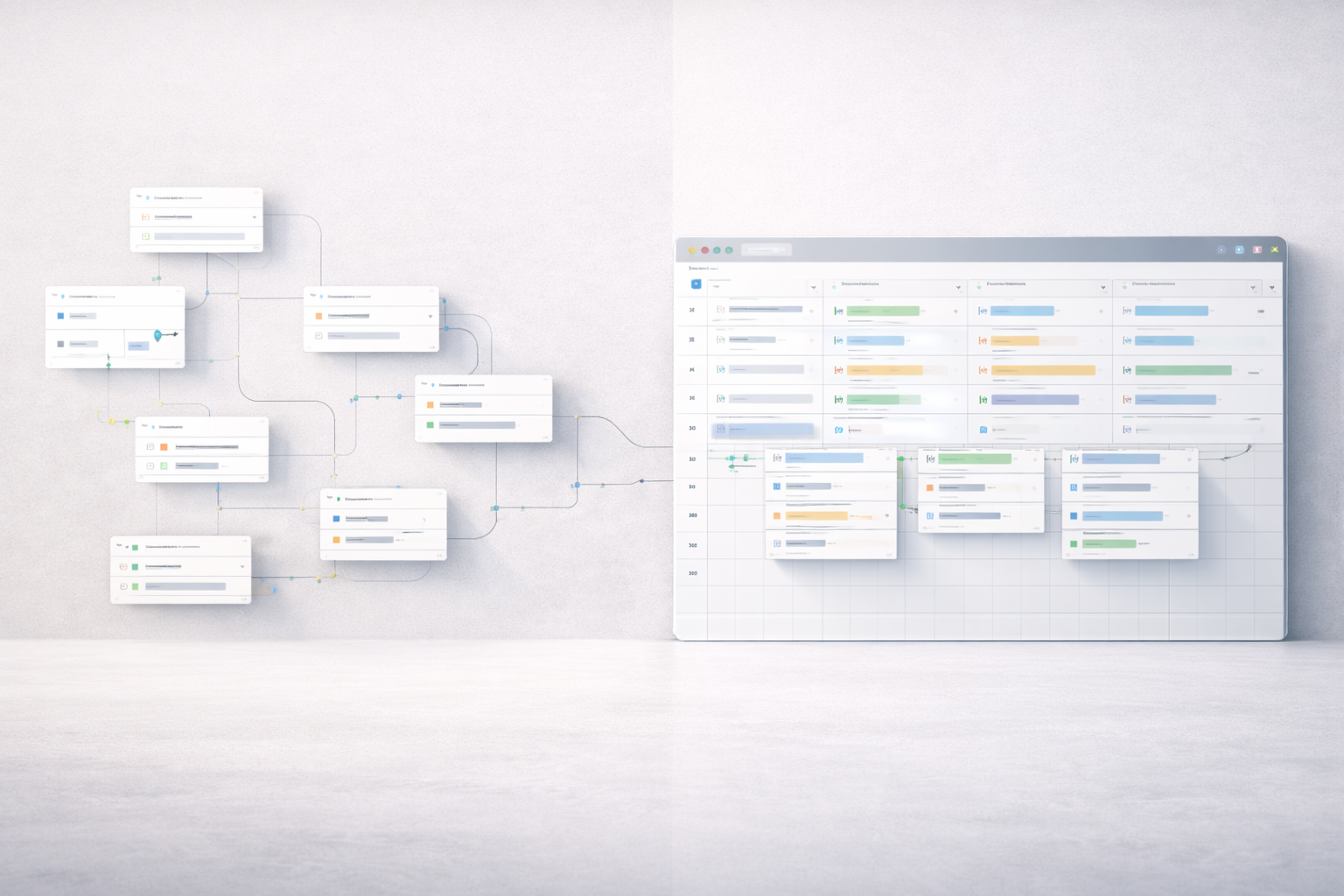
At Singular Innovation, Airtable OMNI is used to enable transformation at the system level.
The approach is consistent:
- Start with workflows, not tools
- Design for execution, not reporting
- Use automation to reinforce structure
Learn more about Singular Innovation at
https://www.singular-innovation.com/
Explore operational partners at
https://www.singular-innovation.com/partners
See real systems built on Airtable OMNI at
https://www.singular-innovation.com/success-stories
Conclusion. Airtable OMNI Enables Transformation Because It Is a System
Digital transformation does not fail because automation is weak.
It fails because automation is applied without restructuring how work exists.
Airtable OMNI enables real digital transformation by:
- Making workflows explicit
- Embedding automation inside the system
- Preserving clarity as operations scale
Automation optimizes tasks.
Airtable OMNI transforms operations.
If your automation efforts have increased activity but not clarity, the problem may be structural.
Schedule a 30-min discovery call to evaluate whether Airtable OMNI can support real digital transformation in your operations:
This article was developed with the assistance of AI tools and reviewed by the Singular Innovation team for accuracy and context.
Heading
Dolor enim eu tortor urna sed duis nulla. Aliquam vestibulum, nulla odio nisl vitae. In aliquet pellentesque aenean hac vestibulum turpis mi bibendum diam. Tempor integer aliquam in vitae malesuada fringilla.
Mi tincidunt elit, id quisque ligula ac diam, amet. Vel etiam suspendisse morbi eleifend faucibus eget vestibulum felis. Dictum quis montes, sit sit. Tellus aliquam enim urna, etiam. Mauris posuere vulputate arcu amet, vitae nisi, tellus tincidunt. At feugiat sapien varius id.
Heading 3
Eget quis mi enim, leo lacinia pharetra, semper. Eget in volutpat mollis at volutpat lectus velit, sed auctor. Porttitor fames arcu quis fusce augue enim. Quis at habitant diam at. Suscipit tristique risus, at donec. In turpis vel et quam imperdiet. Ipsum molestie aliquet sodales id est ac volutpat.
Tristique odio senectus nam posuere ornare leo metus, ultricies. Blandit duis ultricies vulputate morbi feugiat cras placerat elit. Aliquam tellus lorem sed ac. Montes, sed mattis pellentesque suscipit accumsan. Cursus viverra aenean magna risus elementum faucibus molestie pellentesque. Arcu ultricies sed mauris vestibulum.
Heading 4
Morbi sed imperdiet in ipsum, adipiscing elit dui lectus. Tellus id scelerisque est ultricies ultricies. Duis est sit sed leo nisl, blandit elit sagittis. Quisque tristique consequat quam sed. Nisl at scelerisque amet nulla purus habitasse.

Heading 5
Morbi sed imperdiet in ipsum, adipiscing elit dui lectus. Tellus id scelerisque est ultricies ultricies. Duis est sit sed leo nisl, blandit elit sagittis. Quisque tristique consequat quam sed. Nisl at scelerisque amet nulla purus habitasse.
"Ipsum sit mattis nulla quam nulla. Gravida id gravida ac enim mauris id. Non pellentesque congue eget consectetur turpis. Sapien, dictum molestie sem tempor. Diam elit, orci, tincidunt aenean tempus."
Heading 6
Nunc sed faucibus bibendum feugiat sed interdum. Ipsum egestas condimentum mi massa. In tincidunt pharetra consectetur sed duis facilisis metus. Etiam egestas in nec sed et. Quis lobortis at sit dictum eget nibh tortor commodo cursus.
What is Singular Innovation
Lorem ipsum dolor sit amet, consectetur adipiscing elit. Suspendisse varius enim in eros elementum tristique.